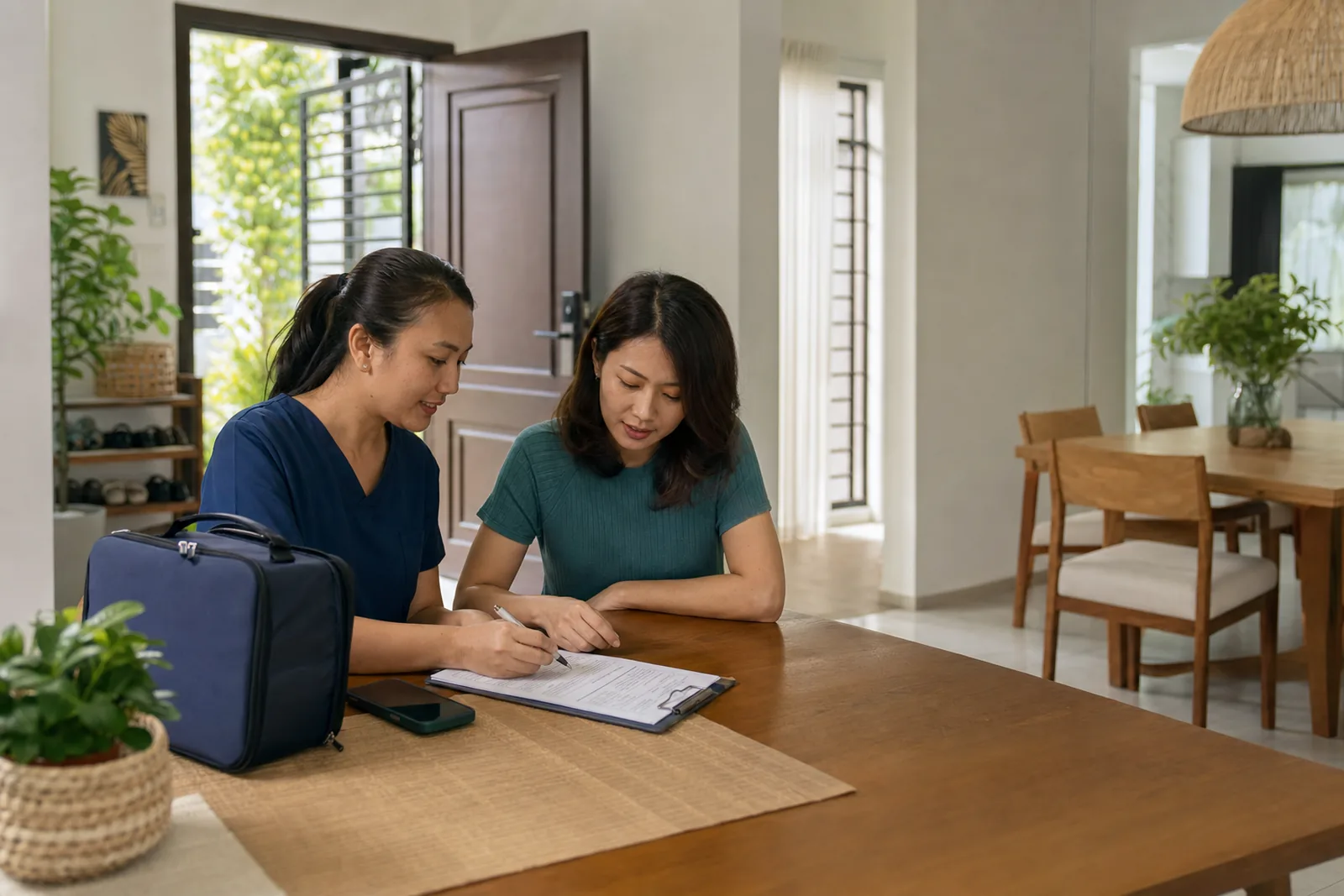
Secure Home Access When the Patient Cannot Answer the Door
Choose the least-access method that still makes the visit reliable: a trained household contact, building-authorised entry, a controlled lockbox or individually issued credential where lawful and agreed. Record the property identifier, permitted time, verification steps, issuer, recipient, backup contact and revocation process. Send sensitive details only through the agreed private channel shortly before need. The nurse verifies identity, logs entry and exit, never labels a key with the full address, and does not admit other people. Define the no-response sequence and when welfare or emergency services must be contacted.
Who this guide is for
- People who are bedbound, weak, deaf or unable to operate the door
- Families living away from the patient
- Nurses visiting apartments with guards, lifts or controlled entry
Choose the smallest access permission that works
Map the building entrance, guard or intercom, lift, unit door, internal barriers and the patient’s ability to hear, speak, move and operate each point. Prefer a present contact or building-authorised process where practical. If a key, lockbox or credential is needed, obtain household and property permission and limit it to the specific user and period.
Avoid hiding keys in common places or sharing a permanent code with rotating staff. Separate the property address from the credential where possible and maintain a backup contact who can verify the visit without disclosing access to an unconfirmed caller.
- Full access chain mapped
- Property permission confirmed
- Credential limited by person and time
- Address separated from secret
Verify entry without sacrificing dignity
Give the patient the nurse’s expected name, provider and arrival window in an accessible format. The arriving nurse shows identification through the agreed method and confirms the patient or authorised contact before using the credential. Entry permission does not permit searching rooms, admitting another person or photographing the home.
Record issue, receipt, use, return and any failed attempt. Keep the door secure during care while preserving emergency exit. If the patient wants a private conversation, the access holder does not automatically remain in the room.
- Expected visitor shared
- Identification checked
- Permission boundaries
- Entry and exit record
Plan failed access and an unwell-person discovery
Define timed steps: call or ring using the accessible method, contact the primary and backup person, check building information, then use the agreed welfare or emergency route. A failed code is not permission to ask neighbours for entry or post the code in a group. Record delay and its effect on time-critical tasks.
If the door appears forced, an unknown person is inside or staff feel unsafe, withdraw and contact the appropriate authority. If the patient is found collapsed, severely breathless, confused or otherwise acutely unwell, activate the clinical emergency plan first and preserve clear access for responders.
- Timed no-response sequence
- No informal credential sharing
- Staff safety boundary
- Emergency responder access
Primary sources
Sources support general principles; the individual treating team’s instructions take priority.
What matters before arranging a visit
Support that may be relevant
- Least-access reliable method
- Arriving nurse identity verified
- Issue return and revocation log
- Sensitive details use a private channel
- No-response and emergency sequence
How a home visit is planned
- Which minimum access method works
- Who verifies the nurse
- Who holds and revokes credentials
- What happens after failed access
- When a welfare or emergency response begins
Ask about secure nurse access when a patient cannot answer the door at home
The WhatsApp message mentions this page and leaves space for your city or suburb. The provider must confirm suitability, scope, timing and fees before any visit.
Ask on WhatsAppSafety boundaries and escalation
- Do not place a full address and access code together in an insecure message or labelled key
- Do not force entry or bypass building controls outside the agreed emergency route
- If the patient is found acutely unwell, clinical emergency action takes priority over routine entry logging
This website is not an emergency service. Call 999 if someone has severe breathing difficulty, chest pain, heavy bleeding, sudden weakness, loss of consciousness or rapid deterioration.
Questions families often ask
Can one access code be shared with every visiting nurse?
A permanent shared code increases risk. Prefer individually controlled, time-limited or logged access where available and agreed.
What if the nurse cannot enter for a time-critical medicine?
Follow the timed failed-access and clinical escalation plan immediately; do not improvise entry or silently skip the task.
Updated: 29 July 2026 • Sources and clinical instructions must be confirmed for each case.