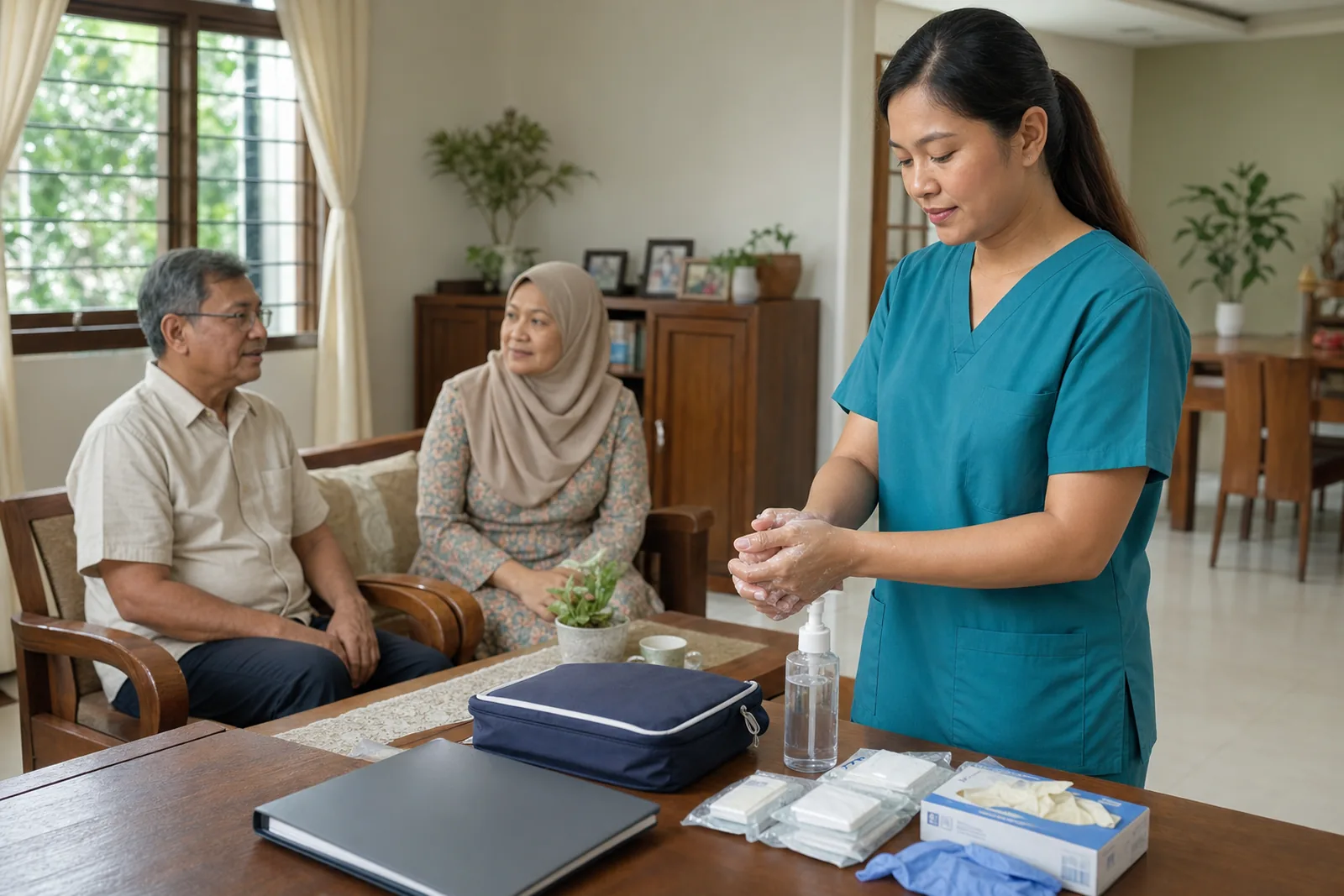
MDRO Home Nursing Coordination
Choose this service when a hospital, laboratory or treating team has identified an MDRO and home visits need one written operational plan. Provide the microbiology or discharge information and named infection-control contact. The nurse should not infer that colonisation requires antibiotics, improvise decolonisation or apply a generic rule to every resistant organism.
Who this guide is for
- People discharged with documented MDRO colonisation or infection and ongoing professional nursing tasks
- Patients with draining wounds, continence needs, urinary devices, vascular access or other care that can expose staff to body fluids
- Families and providers who need the same practical precautions across repeated home visits and transfers
Turn the laboratory label into an operational brief
Collect the discharge summary and the most specific available microbiology information: organism, resistance or susceptibility result, body site, specimen date and whether the treating team describes colonisation or clinical infection. Add current symptoms, antimicrobial name and end date if treated, allergies, wounds, continence, devices and the clinician or infection-control service that owns decisions.
Write the plan in plain language for every visiting worker. It should state the exact care tasks, supplies, protective equipment, waste and laundry method, equipment rules, deterioration triggers and transfer contact. Review it when the organism, wound, device, symptoms, treatment or responsible service changes.
- Exact organism and site
- Status and treatment owner
- Task inventory
- One current written brief
Match precautions to exposure during the visit
Use Standard Precautions for all care and add the instructed measures for the organism and task. Gloves and gown or apron may be needed where there is contact with uncontrolled secretions, draining wounds, pressure injuries, stool incontinence, ostomy contents or contaminated surfaces. Protective equipment is removed safely and never replaces hand hygiene.
Bring only what is needed. Where practical, keep reusable patient-care equipment in the home for that person. Clean and disinfect non-critical equipment according to the manufacturer and infection-control plan before it leaves; if immediate processing is not possible, contain and label it for safe transport under the provider’s procedure. Never move a visibly contaminated item loose between homes.
- Exposure-based protection
- Hand hygiene at care moments
- Patient-specific equipment
- Controlled removal and disinfection
Protect continuity without stigmatising the household
MDRO colonisation can exist without symptoms, and the precautions needed at home are not automatically the same as hospital room placement. Explain the practical actions the household actually needs—hand hygiene, covering draining wounds, safe handling of body fluids and not sharing prescribed medicines—without labelling the person dangerous or imposing unsupported social exclusion.
Before a clinic visit, ambulance transfer, hospital return or change of home-care provider, communicate the organism, site, colonisation-or-infection status, active symptoms, devices, current treatment and required precautions to the receiving service. Do not use a negative assumption or an arbitrary time period to stop precautions; obtain the responsible team’s decision.
- Neutral, factual explanation
- Proportionate household actions
- Advance transfer communication
- Clinician-owned precaution changes
Primary sources
Sources support general principles; the individual treating team’s instructions take priority.
What matters before arranging a visit
Support that may be relevant
- Organism and site clarity
- Colonisation versus infection
- Task-specific precautions
- Equipment and transfer control
How a home visit is planned
- What organism, resistance pattern, body site and colonisation-or-infection status are documented
- Which nursing tasks involve wounds, stool, secretions, devices or non-intact skin and therefore change protective equipment
- Which equipment remains patient-specific and how anything leaving the home is contained, cleaned and disinfected
- Who can change antimicrobial or precaution instructions and how the MDRO status is communicated before transfer
Ask about MDRO home nursing coordination at home
The WhatsApp message mentions this page and leaves space for your city or suburb. The provider must confirm suitability, scope, timing and fees before any visit.
Ask on WhatsAppSafety boundaries and escalation
- Do not start, stop or select an antibiotic from an MDRO label alone; treatment depends on clinical infection, organism, susceptibility, site and the responsible prescriber
- Do not attempt routine decolonisation, use leftover topical antibiotics or declare the organism cleared without a specialist-directed plan
- Escalate new systemic illness, rapidly worsening wound or device-site changes, uncontrolled secretions, breathing difficulty, confusion, collapse or other suspected sepsis immediately through the agreed route
This website is not an emergency service. Call 999 if someone has severe breathing difficulty, chest pain, heavy bleeding, sudden weakness, loss of consciousness or rapid deterioration.
Questions families often ask
Does MDRO colonisation mean the person needs antibiotics?
Not automatically. Colonisation means the organism is present without symptoms of infection. Whether treatment is needed depends on clinical assessment, the organism, body site and susceptibility information; the responsible prescriber decides.
Must everyone in the home wear gloves and gowns all day?
No blanket rule applies. Standard Precautions are used for care, with additional protective equipment matched to tasks such as contact with draining wounds, stool, uncontrolled secretions or contaminated items and to the organism-specific plan.
Updated: 29 July 2026 • Sources and clinical instructions must be confirmed for each case.